
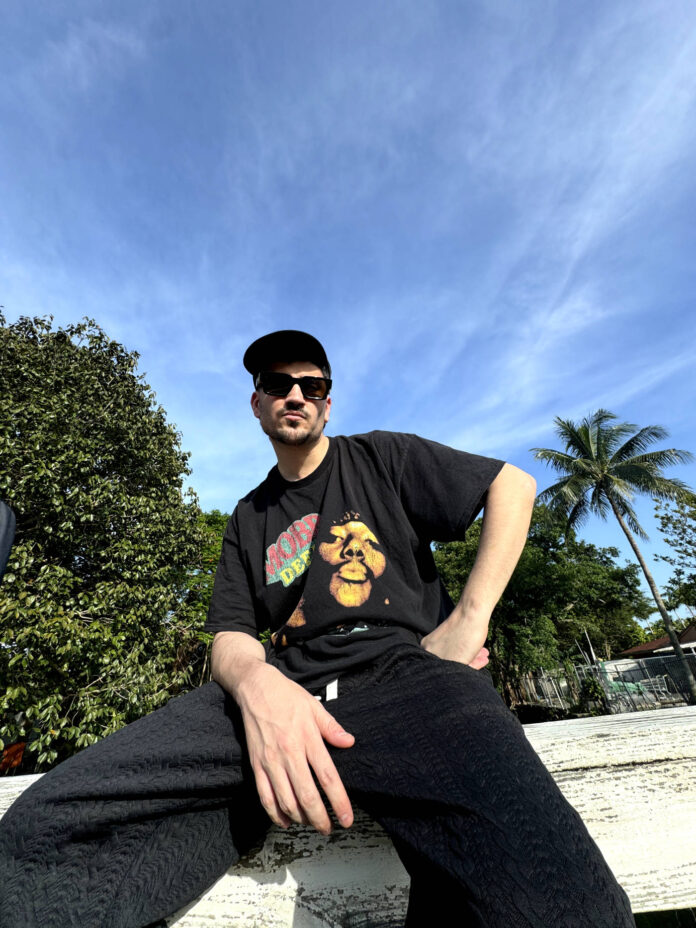
„Quick cuts, short sections and constant movement“—that’s what encompasses vintage Miami Bass mixes for Danny Daze, who, for this edition of the GROOVE Podcast series, goes back to his musical roots and delivers a Mega Mix of the genre that shaped his path like no other.
What did you have in mind when recording this mix?
I wanted the mix to represent my roots in Miami Bass, a genre that still doesn’t get much recognition outside of Miami. That music is a huge part of why I got into bass music in the first place. It was raw, fast and completely built around the energy of the dance floor. The DJs would sometimes play a record for only 30 seconds before cutting into the next one. It wasn’t about long blends or creating a perfect journey. It was about impact. I wanted to bring some of that feeling back with a short, Mega Mix-style recording that shows where everything started for me. Detroit had electro from artists like Cybotron, while Miami had groups like 2 Live Crew. The two sounds were always connected and DJs in both cities would move between them naturally. With the party we’re doing in Berlin, it felt like the right time to put something like this out.
Where did you record it and which setup did you use?
I recorded it in my studio in Miami using 2 Technics 1200’s and an older Vestax 07 Pro mixer. Had that mixer lying around and thought why not since I’m going old school here. I wanted to keep the process close to how these mixes would have originally been approached, quick cuts, short sections and constant movement. The most important part wasn’t the equipment. It was keeping the mix loose and energetic. I didn’t want to over-edit it or clean it up so much that it lost the rawness that made this style exciting in the first place.
What’s the most memorable gig you’ve played so far?
It’s difficult to name one because the gigs that stay with me aren’t always the biggest ones. Usually, it’s a night where the crowd gives you enough trust to take risks and play things that might not work anywhere else. One that stands out is a sunrise set I did back in 2019 in São Paulo at Capslock. One of my favorite events to play. There was a point during that set when everything between the music, the sound system and the crowd completely connected. Those moments are rare. You stop thinking about what you’re going to play next and the night starts moving on its own.
Can you name a secret weapon that you use frequently?
The secret weapon is knowing when to get out of a record. I don’t think every track needs to play for five or six minutes. Sometimes the strongest part is only 30 seconds long. That comes directly from the Hip-Hop/Miami Bass DJs I grew up listening to. They would take the section that mattered, make it hit and immediately move on. That pacing still affects the way I play today, even when I’m playing completely different styles of music.
If I had to name one actual record, it would be Freaky Chakra & Single Cell Orchestra – I Want To Fall.
What do you have coming up?
The Berlin party we’re doing and sharing this side of my musical background with people who may not have heard Miami Bass presented in this way before.
I’m always working on new music, got quite a few collabs being worked on. I’m trying not to talk about everything too early. I’d rather finish the work, make sure it feels right, but it’s a wide range of artists I’’e done collaborations with EP’s with which will come out on my label, Omnidisc, and a few other labels. On another note, I’ve re-opened a venue in Miami called The Pickle alongside its founder Will Renuart and have a record store basically running other of my house. So in case you’re in Miami and wanna dig through, gimme a shout!
